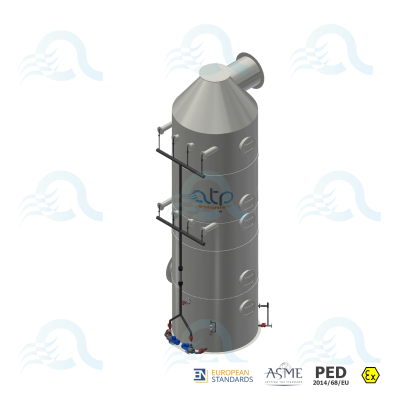
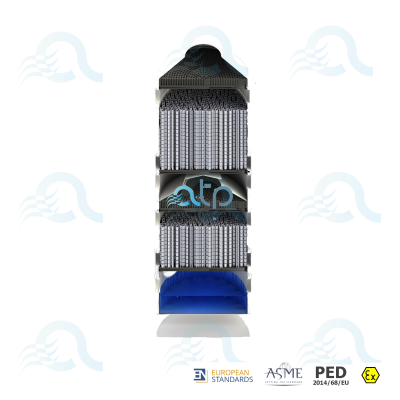
The bioscrubber combines the efficiency of traditional scrubber technology with the advantages of biological treatment to effectively remove gaseous pollutants such as VOCs, NH₃, and odors. Its operating principle is based on the use of a biological activator that biologically degrades pollutants.
In addition to delivering high performance in reducing airborne contaminants, the bioscrubber offers several important operational advantages, including:
Compact system design
Lower operating costs compared to chemical solutions for equivalent applications
Possibility to reuse the spent recirculation solution
No need for special disposal of the exhausted recirculation solution
Sustainable solution
High efficiency
This technology is often combined with ATP Environment biofilters.
Typical applications of the bioscrubber include waste treatment plants, wastewater treatment facilities, and various metalworking processes with odorous, organic, and inorganic emissions.
How does it work?
The polluted gas enters the column and flows upward through the washing liquid in counter-current operation, resulting in the absorption of pollutants along with oxygen. During this process, the contaminants transfer into the liquid phase and are used as nutrients by the biomass contained in the washing liquid. The biomass biologically degrades the pollutants, converting them into carbon dioxide and water.
The purified gas then passes through a demister to remove any residual liquid droplets before exiting from the top of the tower.
Which problem can sort it out?
The ATP BIOscrubber is an innovative and sustainable solution designed to effectively address the removal of odors and other organic and inorganic compounds from air streams with excellent removal efficiencies. It ensures emissions comply with environmental regulations while keeping operating costs low and system management simple and reliable.
Industries involved
Spreadsheet
Download technical specifications by pressing the button below
1. Process description 2. Equipment datasheet 3. Process Flow Diagram (PFD) 4. P&ID 5. Equipment list 6. Line and fluid list 7. Instruments list 8. General arrangement drawings of the equipment 9. Foundation loads 10. Plant layout 2D/3D 11. Utility requirements list 12. System control logic (CSL) 13. I/O list 14. FAT plan and procedure
Air treatment plants manufacturing
1. Conceptual engineering 2. FEED engineering 3. Manufacturing of the equipment 4. Executive documents 5. Delivery 6. Start-up of the plant on site 7. After sales services
After Sales service
1. On site assistance Installation spares Commissioning spares Operational spares (2-5-10 Y) Capital spares
2. Consumables Biological activator Carbon pellets Filtration material for biofilter Other filtration material for static filters
3. Process control PLC remote connection On site visits